Dare to Dance: The Legality of Ballroom Building
Credit: Stock Images
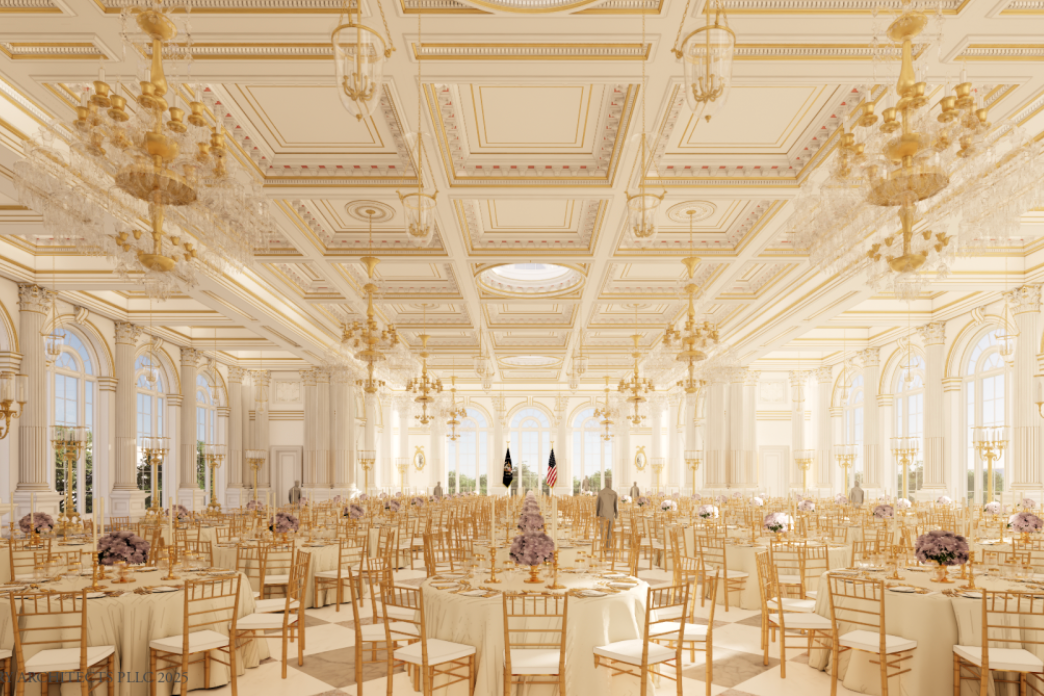
In July 2025, the Trump Administration announced plans to install a ballroom in the White House in order to establish a designated space for accommodating large numbers of guests. In order to make way for a ballroom, the East Wing of the White House was demolished in October 2025 with a substantial lack of oversight, including bypassing congressional review. However, the president’s daring artistic ambitions were met with some pushback from the National Trust for Historic Preservation, a nonprofit organization devoted to preserving historic buildings, which filed a lawsuit against President Trump and the Department of the Interior, claiming that the project required approval by Congress under the Property Clause of the U.S. Constitution. The National Trust for Historic Preservation presented its case in the D.C. District Court, and in December 2025, Judge Richard J. Leon ruled that the Trump Administration must file its plans with the National Capital Planning Commission (NCPC) and the Commission of Fine Arts (CFA). Judge Leon stated that if the administration did not submit plans to both agencies within two weeks, he would stop construction on the ballroom project. On February 19th, 2026, the CFA unanimously approved Trump’s ballroom project with a vote of 6-0. It is perhaps worth bearing in mind that all seven current members of the Commission of Fine Arts were appointed by Trump at various dates in January 2026. Of the seven members, Vice-Chairman of the Commission James McCreary chose to recuse himself from the vote on Trump’s ballroom plan, presumably due to his conflict of interest as the head of the architectural firm leading the project, McCreary Architects. Now, the decision appears to come down to the NCPC on whether construction of Trump’s ballroom can continue or whether it must be stopped. Unlike the CFA, the twelve members on the NCPC are not currently stacked with Trump-appointees; instead, the NCPC is composed of three presidential appointees, two mayoral appointees, and seven ex officio members, including Pete Hegseth, Doug Burgum, Ed Forst, Senator Rand Paul, Congressman James Comer, Mayor Muriel Bowser, and Phil Mendelson. Of the twelve, six are either Trump appointees or members of Trump’s cabinet, while the other six come from an eclectic group of national and D.C. politicians. While the NCPC is currently split between members presumably loyal to the president and those with various interests, a decision in favor of the president should likely be expected. The Republican members on the NCPC hold a slight majority, and aside from the six Trump appointees and members of Trump’s executive cabinet, there are two other Republican members. Aside from political interests, there is also a practical reason why the NCPC might approve the White House ballroom: the East Wing of the White House has already been torn down. Frankly, it would be unreasonable to tear down the East Wing of the White House only to leave it in ruins; there must be something built on the grounds formerly called the East Wing.
Aesthetic Motivations for a Ballroom in the White House
The Trump Administration has claimed that American presidents have “longed” for an open, expansive space for 150 years, dating back to President Ulysses S. Grant. Whether or not such a historical desire for White House expansion existed, it is true that there is a clear lack of room for large gatherings. While the White House Building contains over 100 rooms, an examination of its architectural ground plan illuminates the particular spatial concerns raised. The largest room in the White House is the East Room, which occupies the eastern-most part of the building and is currently used for receptions and ceremonies. While the East Room measures a somewhat spacious 80 by 37 feet and can comfortably fit around 200 people, receptions larger than that have to be moved to a location the Trump Administration has called “large and unsightly,” a tent on the White House lawn. It is worth noting that the usage of tents for formal gatherings is neither unheard of nor unprecedented. For example, the Metropolitan Museum of Art holds its annual Costume Institute Benefit (The Met Gala) in a tented area. Likewise, the tents erected by the White House staff for large formal events often align with the White House's architectural style, and the tents' fabric is typically fashioned to resemble a pediment, columns, and an arcaded vestibule. The aesthetic motivation of the current ballroom can also be seen in the architectural firms chosen for the project. Initially, the administration hired McCreary Architects, an architectural firm headed by James McCreary, a Professor at the School of Architecture at the Catholic University of America. McCreary Architects seemed like a fitting choice in many ways. James McCreary himself has earned numerous accolades and honors in the architectural field. He is a member of the National Council of Architectural Registration Boards, a member of the American Institute of Architects, and a Latrobe member of the Institute for Classical Architecture & Classical America. Throughout his architectural career, McCreary has established a reputation for designing buildings in a Neoclassical Revival style. Thus, McCreary Architects would have been a reputable and fine selection for a building designed in the Neoclassical style. However, the president did not retain McCreary as the chief architect of the ballroom. Instead, by the end of 2025, Trump replaced McCreary Architects with Shalom Baranes Associates as the chief architectural firm, though McCreary Architects remains a source of consultation. According to NPR, there were some “pretty significant disagreements” between Joseph McCreary and the president about the size of the ballroom. Original plans for the ballroom included one that was 90,000 square feet in length, which would have been much larger than the White House itself, which is 55,000 square feet. Currently, the plan has shifted slightly to include a 90,000 square feet two-story building on the east side of the building, and within that building would be the ballroom with a size of 22,000 square feet. While the ballroom itself is much smaller now, it still does not change the fact that the additions to the east of the White House mansion will be larger than the mansion itself. The disagreements over the sizing of the ballroom and the changing of architectural firms reflect how important a grandiose ballroom is to the president and that the president fully intends to build a towering space, regardless of the architectural principles at stake.
Political Motivations for a Ballroom in the White House
While the aesthetic concerns of the White House “tent” are worth taking into consideration, a larger problem of the lack of reception space appears to pertain to international standing and the fact that the governments of most democratic nations have delegated areas to receive guests. For instance, the British government primarily receives guests in the Grand Ballroom of Buckingham Palace, while the French government hosts guests in the Salle des Fêtes, or the “Hall of Festivities,” of the Élysée Palace. From an international standpoint, it would be reasonable for the American government to have a similar space devoted to large ceremonies and banquets. Overall, while there appears to be a strong motivation to construct a large-enough ballroom to receive guests, the question of whether the President of the United States has the singular authority to make such an architectural decision remains a subject of legal debate.
Parsa is a junior at Brown University studying Political Science and the History of Art and Architecture. He is a writer for the Brown Undergraduate Law Review and can be reached at parsa_zaheri@brown.edu.
Luca Feng is a sophomore at Brown University, concentrating in Political Science and Chemical Engineering. He is a staff editor for the Brown Undergraduate Law Review and can be contacted at trevor_feng@brown.edu.