Volunteers or Mercenaries? The Legal Ambiguity for Americans Fighting in Ukraine
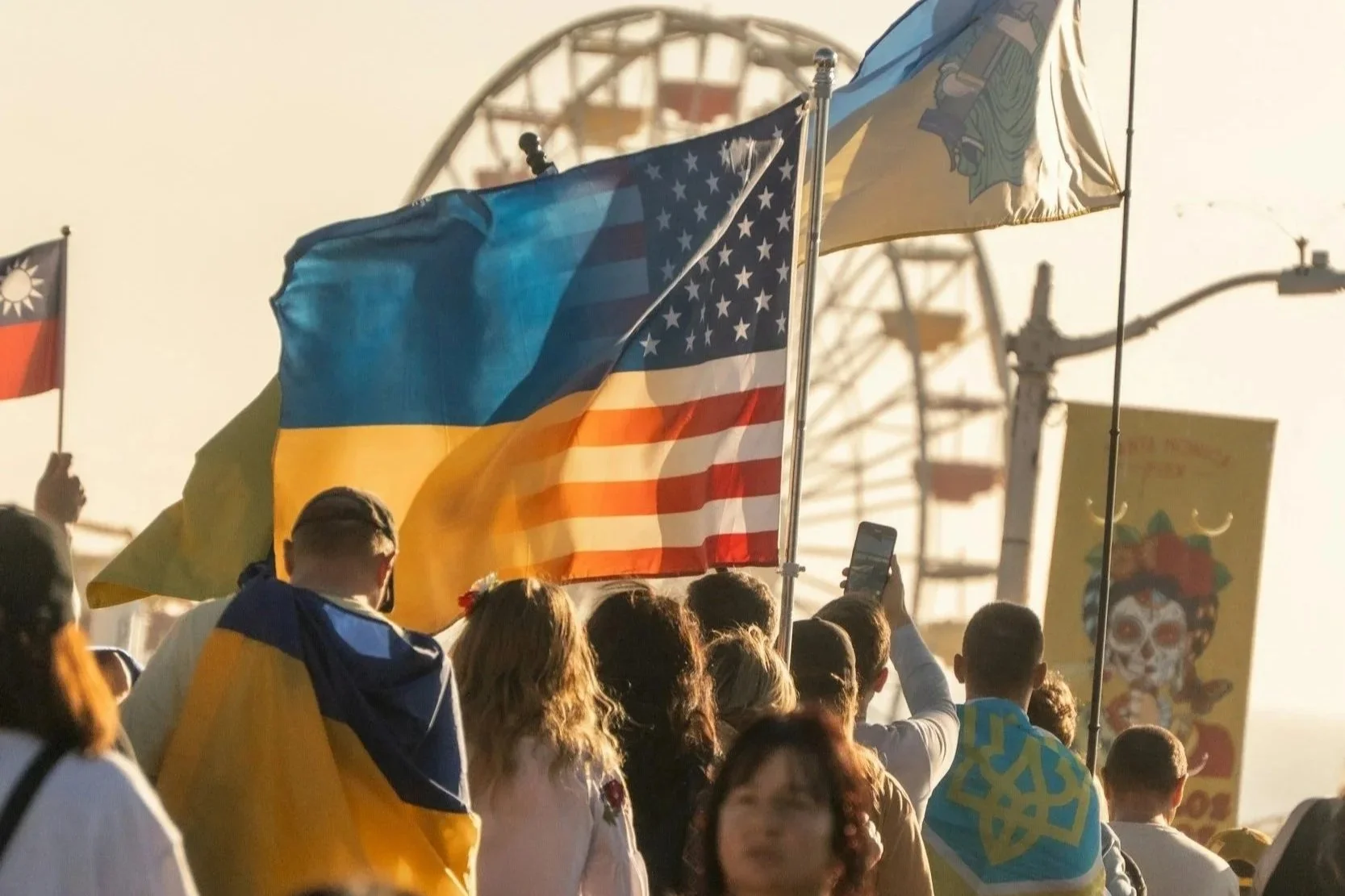
credits to stock images
In the wake of Russia’s full-scale invasion of Ukraine in 2022, Ukrainian President Volodymyr Zelenskyy issued a worldwide call for international volunteers to help defend his country. Thousands responded, including many Americans, all motivated by a desire to stand in solidarity with Ukraine against what they saw as an unjust act of aggression. These volunteers joined Ukraine’s newly formed International Legion for the Defence of Ukraine to defend a democracy under attack and to uphold the same principles of freedom and self-determination that shape their own nation. Yet their bold decision has thrust them into a legal gray zone; U.S. and international laws governing foreign fighters were not written with such morally-driven reasoning in mind.
American volunteer Alexander Drueke, a former U.S. Army soldier, departed to fight in Ukraine in March 2022, only to be later captured by Russian forces who labeled him a “mercenary” rather than a lawful combatant. Drueke and another U.S. veteran, Andy Huynh, were taken prisoner in June 2022 and, according to the Kremlin’s spokesperson, were “soldiers of fortune” not entitled to prisoner-of-war protections. In reality, they had volunteered with Ukraine’s armed forces, making them lawful combatants under the Geneva Conventions, despite Russia’s rhetoric. International law, specifically Article 47 of the 1977 Additional Protocol I, defines a mercenary narrowly, focusing on motivations of private gain and lack of affiliation with a participating party’s military. Foreign volunteers integrated into Ukraine’s official military (and paid the same as equivalent Ukrainian soldiers, if at all) do not meet this definition. This implies, from an international humanitarian law perspective, that most Americans fighting for Ukraine are not mercenaries, but volunteers of Ukraine’s forces entitled to lawful combatant status.
Outdated U.S. Neutrality Laws add an additional layer of ambiguity and pose significant risks. The United States has laws dating back to the 18th and 19th centuries that restrict private citizens’ involvement in foreign wars. Chief among these is the Neutrality Act, first passed in 1794 and amended in 1818, now codified in various sections of the U.S. criminal code. These laws were born of America’s eagerness to avoid being dragged into conflicts by rogue citizens, making it a crime to wage war against foreign states at peace with the U.S. or to enlist in foreign armies from U.S. soil without government authorization. For example, 18 U.S.C. §958 prohibits any U.S. citizen within U.S. jurisdiction from accepting a commission in a foreign military that is at war with a nation at peace with the United States. Similarly, 18 U.S.C. §959 forbids anyone in the U.S. from enlisting or recruiting others for service in a foreign army, and §960 bans launching an unofficial “military expedition or enterprise” from U.S. territory against a friendly nation. On paper, these provisions could apply to Americans heading off to fight Russian forces in Ukraine, since the U.S. is not officially at war with Russia. An American within the United States who formally joins the Ukrainian Foreign Legion or organizes a group to fight Russia might technically be committing a federal crime punishable by fines or imprisonment.
In modern times, however, these antiquated neutrality laws have rarely been enforced against individuals motivated by altruistic motives. The statutes contain a notable geographic loophole: they apply to acts done “within the United States.” This means an American who travels abroad and joins a foreign army arguably does not violate the letter of the Neutrality Act. Historically, many Americans have taken advantage of this ambiguity. For example, nearly 3,000 Americans fought against fascism in the Abraham Lincoln Brigade during the Spanish Civil War (1936–39). While the U.S. was officially neutral, they joined in Spain, so their service did not lead to Neutrality Act prosecutions. Similarly, in 1941 the famed “Flying Tigers” volunteer pilots in China were organized overseas, enabling Americans to fight Japan in the Second Sino-Japanese War prior to U.S. entry into World War II. In both cases, the U.S. government largely turned a blind eye or quietly approved so long as the Neutrality Act’s technicalities were not violated.
For those Americans who do fight in Ukraine and then return home, their situation is anomalous. They are neither hailed as veterans nor treated as criminals by the U.S. government; therefore, they exist in a kind of legal and social limbo. Unlike U.S. service members, these volunteers served without any official status or recognition from their own government. If they are wounded or traumatized, they are not eligible for Veterans Affairs support or military honors, since they wore another country’s uniform. If they are killed in action, their families do not receive the benefits that military families normally would. In fact, the Ukrainian government has stepped in to provide compensation with roughly $400,000 in survivor benefits to families of foreign volunteers killed under contract with Ukraine. From the U.S. perspective, though, these fighters died in a private capacity. By early 2025, at least 50 Americans had been killed fighting in Ukraine (40 of them U.S. military veterans), yet their names end up on makeshift memorials in Kyiv rather than any U.S. roll of honor. Their bodies, when recoverable, were brought home quietly, often with help from Ukraine or private groups, not through U.S. military channels.
At the same time, American volunteers have generally not been prosecuted upon their return. U.S. officials have shown little interest in charging Ukraine vets under the Neutrality Act or other laws, absent some other wrongdoing. As long as a volunteer didn’t engage in illegal conduct (like fighting for a designated terrorist group or committing war crimes), U.S. law enforcement has so far been hands-off. The volunteers are essentially ignored by U.S. law, neither authorized nor explicitly prohibited. Even the Uniform Code of Military Justice (UCMJ), which governs American armed forces, has no jurisdiction over civilian volunteers. Notably, active-duty personnel are barred from freelancing in foreign wars; any U.S. soldier who absented themselves to fight for Ukraine would face court-martial for desertion or misconduct. However, the Americans in Ukraine have been mostly ex-military or private citizens outside the reach of the UCMJ. Ultimately, this system leaves these fighters in a legal gray zone. As one commentator put it, they come home to find their status “in limbo”: not formally acknowledged as veterans and always under the shadow of potential legal risk because of vague laws.
The Ukraine volunteer phenomenon exposes how outdated U.S. statutes fail to address 21st-century realities. Congress may need to update U.S. law to differentiate mercenary activities from bona fide volunteer service in allied armed forces. Notably, in March 2022 as the Ukraine war escalated, the Volunteer Fighters Exemption Act of 2022 was introduced to carve out an exception for Americans fighting in Ukraine. This bipartisan bill proposed a 10-year shield against prosecution under neutrality laws for U.S. citizens who join Ukraine’s defense against Russia. According to then-Representative Markwayne Mullin, a sponsor of the bill,, it would “waive criminal liabilities for the good-hearted, freedom-loving Americans” moved to fight for Ukraine’s freedom. While the bill did not advance, it underscores a recognition that current law is too blunt.
The war in Ukraine has exposed a major legal gap for Americans who volunteer in foreign conflicts for moral reasons. They are not mercenaries in the traditional sense, but U.S. law fails to make this distinction, leaving returning fighters in a legal gray area of being neither criminals nor veterans. To fix this, policymakers should modernize outdated neutrality laws, creating clear rules that deter illicit mercenary activity while recognizing responsible service in support of allies. In an era of rising authoritarian threats, U.S. citizens will still continue to step forward, even if the U.S. government is hesitant to deploy troops. The law must be prepared to treat them fairly and draw a clear line between unlawful mercenaries and honorable volunteers.
Olha Burdeina is a junior at Brown University concentrating in Political Science and International and Public Affairs. She is a staff writer for the Brown Undergraduate Law Review and can be contacted at olha_burdeina@brown.edu
Daniel Shin is a junior at Brown University studying Economics and International and Public Affairs. He is an editor for the Brown Undergraduate Law Review and can be contacted at sangjun_shin@brown.edu.
Alice Kovarik is a sophomore at Brown University studying Economics and International and Public Affairs. She is an editor for the Brown Undergraduate Law Review and can be contacted at alice_kovarik@brown.edu