The Unitary Executive Theory and the Modern Presidency
Credit: Stock Images
I do solemnly swear (or affirm) that I will faithfully execute the Office of President of the United States, and will to the best of my Ability, preserve, protect and defend the Constitution of the United States.
Every man to hold the office of President of the United States—who has sat behind the Resolute Desk and carried the nuclear football—has raised their right hand and sworn the Oath of Office. The words of the Oath are weighty—as is the job. The President serves as the Commander-in-Chief of the armed forces, can grant pardons, issue executive orders, nominate ambassadors, judges, and other public officers, and veto legislation passed by both chambers of Congress. No position comes with more responsibility or risk than the presidency.
From the earliest days of the republic, the oath has symbolized not only a commitment to the Constitution but a central constitutional tension: how much power should a single individual wield? This question lies at the heart of the Unitary Executive Theory and continues to shape the modern presidency.
Article II of the Constitution outlines the roles and responsibilities of the President, from the ability to request written opinions from Cabinet members to the State of the Union to the reception of ambassadors. Though the President is the nation’s ceremonial, diplomatic and political leader, most of his powers are subject to the concurrence of Congress. Foreign treaties and nominations, for instance, must be approved by two-thirds of the Senate, and Congress retains the power of the purse, meaning it must approve funding for executive actions. Similarly, executive orders are subject to judicial review.
The debate over the limits of the president’s power is as old as the office of the president itself, and one of the most controversial aspects has been the president’s ability to remove appointees to executive agencies. Representatives during the founding era believed it seemed logical that, if the president needed Congress’s approval to appoint a Cabinet member, so too would he need their approval to dismiss them. Over the course of a congressional debate known as the Decision of 1789, however, the founders reached the conclusion that the president could remove the secretaries of the three original departments (State, Treasury and War) with unilateral authority. The nation's first presidents exercised this power liberally.
James Madison was the strongest founding-era proponent of the president’s removal power. He wrote in a letter to Edmund Randolph that he thought it wise to minimize the Senate’s input in Executive affairs. In Madison’s view, this would give the president a greater sense of responsibility over his appointees. He believed that, if the President did not act to remove one of his own appointees who acted against the interest of the United States, this would subject “[the president] to impeachment himself, if he suffers them to perpetrate with impunity high crimes or misdemeanours against the United States, or neglects to superintend their conduct.” Similarly, Alexander Hamilton believed that the removal power would hold the President accountable for the public good. This early understanding of executive power persisted into the nineteenth century, but it was not until the presidency of Franklin D. Roosevelt that the scope of presidential authority underwent a dramatic transformation.
President Roosevelt’s New Deal significantly expanded presidential power, as the architecture of the New Deal shifted the “chief executive” into a central policy-making actor. This period saw the creation and expansion of the executive branch’s regulatory, welfare, and administrative authority, as well as an emphasis on expert leadership of executive agencies. This expansion culminated in Humphrey’s Executor v. United States (1935), in which the Court held that President Roosevelt did not have “illimitable power of removal” and could not fire the commissioner of the Federal Trade Commission, William Humphrey, for fear that Humphrey would block the President’s policies. In the unanimous opinion, Justice Sutherland wrote that, in the case of executive agencies established by Congress and with the power to exercise some legislative or judicial powers, members should be protected from removal so they could be insulated from the whims of their appointers. This decision effectively limited the President’s removal power: judicial doctrine recognized new, independent zones of governance that insulated certain agencies from direct presidential oversight. Humphrey’s Executor was reaffirmed by Wiener v. United States in 1958.
The Unitary Executive Theory, as we know it today, began gaining traction in conservative legal circles during the Reagan administration. In the 1988 case Morrison v. Olson, the Supreme Court held that the Attorney General could appoint an independent counsel to prosecute government officials. The statute in question, the Ethics in Government Act, sought to rebuild public trust in the government following the Nixon administration and sought to create a way to investigate ethics violations after President Nixon fired the man investigating him for the Watergate scandal. Justice Scalia was the lone dissenter, arguing that without oversight from the president, an independent counsel held the unchecked, extraordinary power to indict top officials within the executive branch. Without being subjected to oversight by the Justice Department or the president himself, the government’s lawyer, in Scalia’s view, could carry out political attacks and indictments. He also wrote that the Vesting Clause—Article II, section 1, clause 1 of the Constitution—vests not “some of the executive power, but all of the executive power” in the President of the United States.
In 1997, Steven G. Calabresi of Northwestern Pritzker School of Law and Christopher S. Yoo of Penn Law School published The Unitary Executive During the First Half-Century, which cemented the theory and propelled it to the attention of the Supreme Court. While the Reagan era gave the Unitary Executive Theory intellectual momentum, it was during the presidency of George W. Bush that the theory became a practical instrument for expanding executive authority in national security matters. In the last two decades of the twentieth century, the phrase “unitary executive” was used to describe executive branch policies in twenty-seven documents. During the eight years of the Bush administration, that number quadrupled.
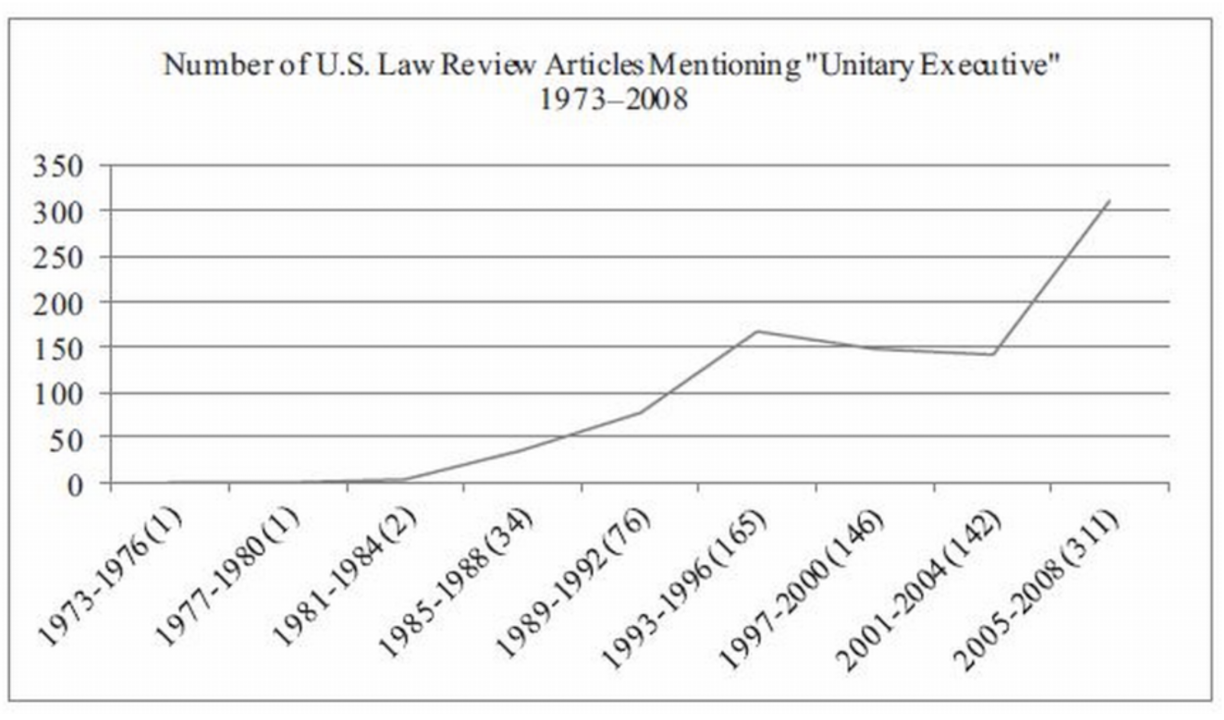
As President Bush orchestrated the nation’s response to the 9/11 attacks and the 2003 invasion of Iraq, the Unitary Executive Theory and a broad reading of presidential power legitimized his actions. The theory provided the constitutional rationale for many of the administration’s most controversial policies, including “Enhanced Interrogation Techniques” and an expansion of the state secrets privilege. President Bush’s Office of Legal Counsel supported the President’s detention and trial policies in the War on Terror, declaring that “the President has inherent authority as Commander in Chief to convene such tribunals even without authorization from Congress.” Under this framework, the executive branch claimed unilateral power to detain and try suspected terrorists, authorize enhanced interrogation techniques, and conduct surveillance operations with minimal oversight. The Bush administration also expanded the usage of executive privilege, the principle that the president may withhold information from Congress when it is in the public interest.
In Seila Law LLC v. Consumer Financial Protection Bureau (2020), the Supreme Court, without explicitly overruling Humphrey’s Executor, demonstrated receptiveness to a broad presidential removal power. In Seila, the Court invalidated the CFPB’s structure, reasoning that an agency led by a single director (as opposed to a group of commissioners) insulated from presidential oversight “lacks a foundation in historical practice and clashes with constitutional structure by concentrating power in a unilateral actor insulated from Presidential control.” This opinion reflects the rising popularity of the unitary executive theory, one favored by the current Trump administration. In 2022, Bill Barr, President Trump’s former Attorney General, posited that, “Constitutionally, it is wrong to conceive of the President as simply the highest officer within the Executive branch hierarchy. He alone is the Executive branch. As such, he is the sole repository of all executive powers conferred by the constitution” (emphasis in original). The trend raises complex constitutional and ethical questions for the executive branch, as employees are forced to face conflicts between loyalty to the President and adherence to their oath to the Constitution.
As legal scholar Jack Goldsmith observes, however, “there’s no canonical definition” of the unitary executive theory, leaving its boundaries—and its implications for the balance of powers—open to continuing interpretation and debate. The forthcoming decisions, therefore, in Trump v. Cook (a pending decision on the emergency docket concerning whether the president can fire a member of the Federal Reserve) and Trump v. Slaughter (concerning whether the president can remove a commissioner of the Federal Trade Commission, with oral arguments slated for December 8) will be vital in shaping the role of executive power and the independence of executive agencies.
Isabella Gardiner is a sophomore studying history. She is a writer for the Brown Undergraduate Law Review and can be reached at isabella_gardiner@brown.edu
Aidan Fogarty is a sophomore concentrating in International and Public Affairs. He is a staff editor for the Brown Undergraduate Law Review and can be contacted at aidan_fogarty@brown.edu.
Alice Kovarik is a sophomore at Brown University studying Economics and International and Public Affairs. She is an editor for the Brown Undergraduate Law Review and can be contacted at alice_kovarik@brown.edu.